

As a soccer fan, longtime player, coach of my twins’ soccer team, and someone who’s worked in sports medicine, I’m pumped. People from all over the world are coming to Atlanta for one of the most exciting times in sports.
Atlanta was selected to host because it checks every box: we’ve got a world-class stadium, a huge soccer fanbase, and elite medical infrastructure, among many other criteria. OXOS is honored to be part of the burgeoning medical community here that’s ready to support the world’s top athletes, and we are uniquely positioned to share an inside look at what elite soccer medicine requires.
Soccer demands medical imaging that keeps pace with the game. Portable X-ray is a critical lever that top sports teams are using to improve real-time access to information at the point of need.
Soccer Injuries Are Fast and Furious
Soccer is a fast-paced, entertaining game. But its intensity also paves the way for high-frequency injuries. Sprints, collisions, aerial challenges, and hard falls can result in foot and ankle sprains, stress fractures, knee injuries, and wrist or hand injuries.
To make matters more complicated for sports physicians: Many common soccer injuries are ambiguous on clinical exam alone. A player limping off the field could have a bad bruise, or it could be a fracture. Treatment, and determining whether the athlete can return to play, depends on the diagnosis. Accurate diagnoses require imaging. And for the longest time, getting that imaging was a slow, multi-step process making it impossible to know for sure if you can keep a player in.
Traditional Imaging Workflows Weren’t Built for Soccer
Typically, when an injury happens during soccer, the player is removed from the field and transported to a hospital or off-site imaging center. They wait for results, and then figure out next steps. Best case, that process takes an hour or two. For club and collegiate teams, a quick diagnosis might mean the athlete can return to play, but by then the game is long over.
The clock doesn’t stop because a player goes down, or because the imaging center is backed up. When incidents happen, medical teams are forced into an uncomfortable position of having to make a fast judgment call without diagnostic certainty. If they err on the side of caution, a critical player may be kept on the sidelines unnecessarily. On the opposite end of the spectrum, a player may return to play too soon and exacerbate injury.
At the professional level, a player who comes off the field mid-match doesn’t come back on. But diagnostic urgency remains: how quickly can the medical team assess the injury, make a treatment decision, and prepare the athlete for what’s ahead?
Point-of-Need Imaging to the Rescue
Portable X-ray can make a real difference here, closing the gap between injury and decision. These are the situations OXOS was created to solve. 
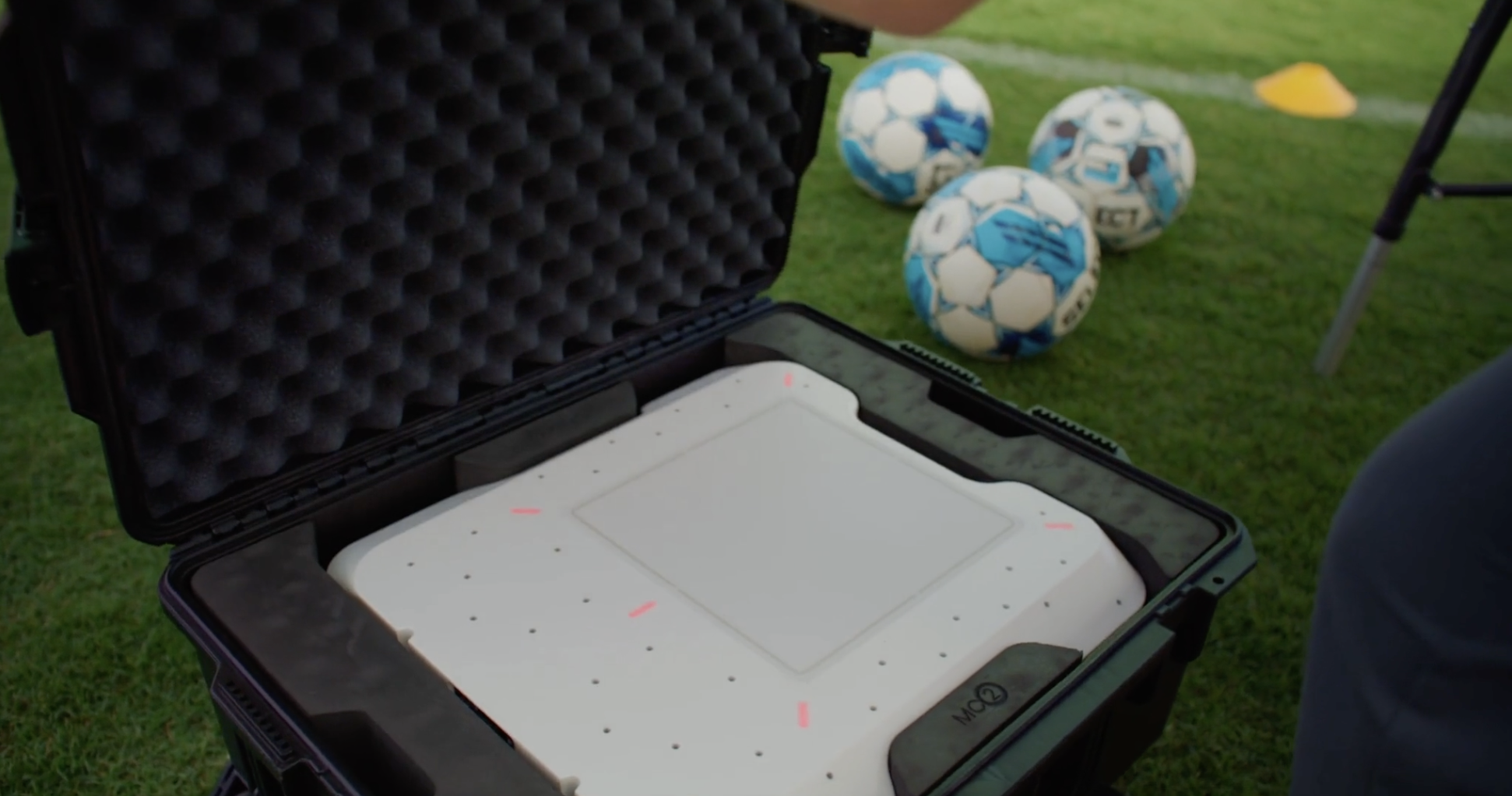
Our most travel-friendly portable X-ray device, the MC2 Go, is wireless, lightweight, and ships with a rugged travel case that’s perfect for sports teams on the go. Athletic trainers can set it up and capture images quickly. With one click, they can send images directly to the team physician or orthopedic surgeon.
Diagnosis can happen on the spot. And while on this stage, players won’t return mid-game, immediate clarity means the medical team can move from uncertainty to a treatment plan without losing critical time.
MC2 is also highly versatile, with four imaging modes including Dynamic Digital Radiography (DDR), which allows medical teams to capture joint motion in real time. DDR is especially beneficial when evaluating instability and subtle findings that a standard X-ray would miss. In a sport defined by complex lower extremity mechanics, diagnostic depth and dynamism matter.
A common example in soccer is ankle injuries and the risk of chronic instability. There are ligaments that become stretched and loose, leaving the joint vulnerable to repeated injury. Having the technology to see exactly how these damaged ligaments behave motion-wise is a game-changer for keeping elite athletes healthy and match-ready.
The Impact: Faster Answers, Better Outcomes, More Time on the Field
When a fracture can be confirmed or ruled out in minutes rather than hours, return-to-play decisions are more confident. At the club and collegiate level, players who are cleared to return do so faster and with certainty. At the top level, the value shifts to speed of assessment and treatment: getting the right diagnosis immediately so a care plan can be enacted without delay.
As fans flood Atlanta, OXOS is proud to be part of what makes this city’s medical ecosystem stand out. Our portable X-ray device brings imaging to the point of need, supporting professional sports organizations.
See how MC2 brings point-of-need imaging to your sports medicine practice or schedule a demo directly.
FAQ
Why do soccer teams need X-ray imaging?
Soccer is a high-impact sport that produces a consistent volume of bone and joint injuries, many of which look similar on clinical exam but require very different treatment. Without imaging, it’s difficult to distinguish a bruise from a fracture, or a sprain from structural instability. That distinction directly determines whether a player returns to the field, sits out the rest of the match, or needs immediate intervention. X-ray gives medical teams the diagnostic certainty to make those calls confidently and quickly.
What injuries in soccer typically require imaging?
The most common soccer injuries that benefit from X-ray imaging include foot and ankle fractures from awkward landings or collisions, stress fractures from repetitive high-impact movement, knee injuries involving bone or joint structures, and wrist or hand fractures from bracing against the turf during falls.
How does portable X-ray support return-to-play decisions?
By bringing imaging to the point of need, portable X-ray dramatically shortens the time between injury and diagnosis. Instead of transporting a player off-site and waiting for results, medical teams can capture and review images in minutes — on the sideline, in the locker room, or in the training facility. That speed turns return-to-play from a judgment call into an informed decision, reducing both unnecessary downtime and the risk of sending a player back in with an undiagnosed injury.
Can MC2 be used in the training room?
Yes. MC2 is wireless and lightweight, and the MC2 Go configuration includes a rugged travel case designed for exactly these environments. It doesn’t require a lead-lined room or dedicated imaging suite.
What makes MC2 different from standard portable X-ray systems?
Many portable X-ray systems are still heavy, with many weighing in at 100+ pounds, and they are limited to capturing static fluoroscopy images. MC2 altogether weighs less than 25 pounds (the emitter being 8 pounds and the cassette at 13.5) while offering four imaging modes including Dynamic Digital Radiography (DDR). DDR captures joint motion in real time, allowing physicians to evaluate instability and subtle findings that a standard X-ray would miss. Its ease of use, four imaging modes, and seamless image sharing differentiate MC2 against other portable X-ray options.